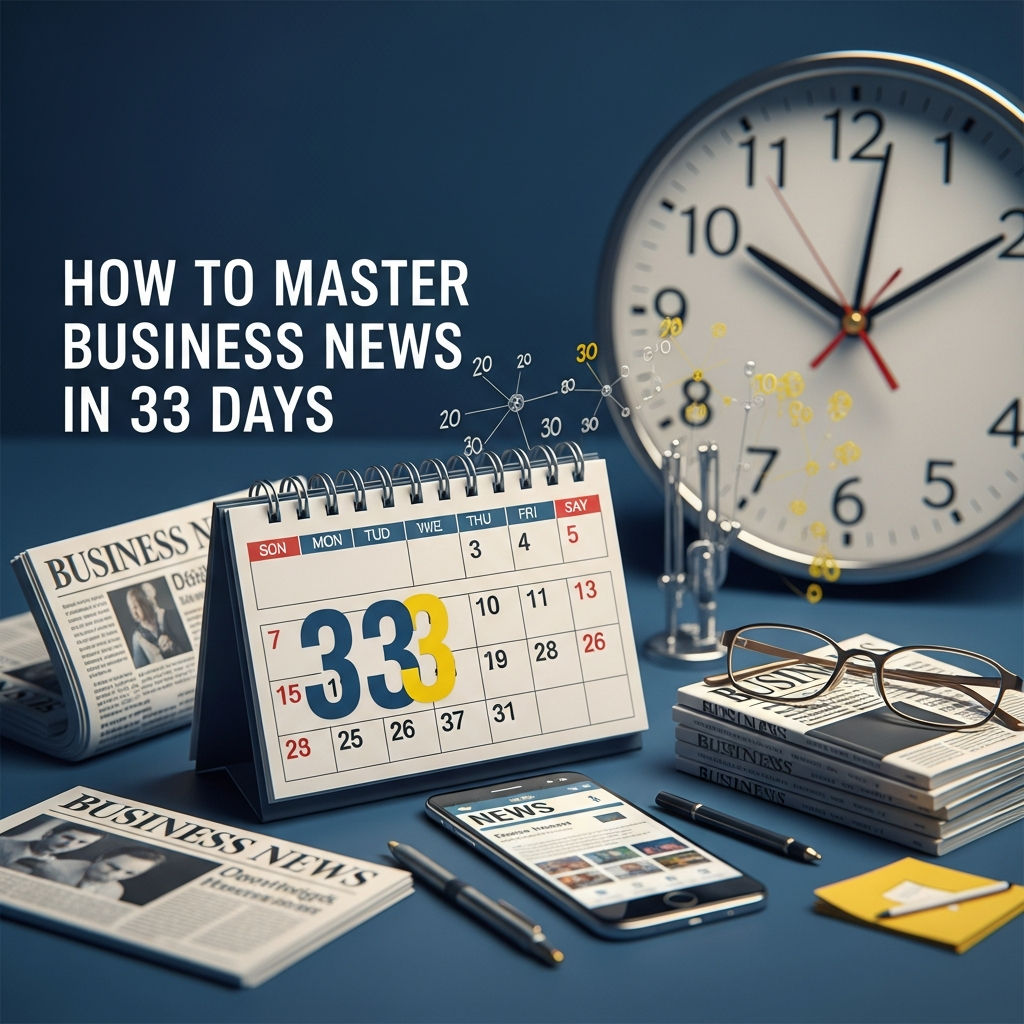
How to Master Business News in 33 Days: Your Complete Roadmap
In an era where information moves at the speed of light, staying informed about the business world is no longer just for Wall Street traders or corporate executives. Whether you are an entrepreneur looking for market gaps, a professional aiming for a promotion, or an investor seeking to grow your portfolio, understanding business news is a superpower. However, the sheer volume of data can be overwhelming.
Most people fail to keep up because they lack a system. They jump into complex financial reports without knowing the terminology or follow “hot tips” without understanding the underlying economic drivers. This article provides a structured, 33-day plan to take you from a confused observer to a savvy consumer of global business intelligence.
Phase 1: Building the Foundation (Days 1–7)
The first week is about immersion and tool selection. You cannot master business news if you are looking at the wrong sources or getting bogged down by “noise” (sensationalist headlines that lack substance).
- Day 1-2: Curate Your Sources. Stop relying on social media algorithms. Bookmark reputable sources like Reuters, Bloomberg, The Wall Street Journal, and The Financial Times. Download their apps and set up specific notifications for “Breaking News.”
- Day 3-4: Learn the Lexicon. Business news has its own language. Spend these days learning 20 essential terms, such as “Fiscal Policy,” “Monetary Policy,” “Market Capitalization,” “EBITDA,” and “Yield Curve.”
- Day 5-6: Identify the Big Players. Start recognizing the names that move markets. This includes central banks (The Fed, ECB), major indices (S&P 500, FTSE 100), and “The Magnificent Seven” tech stocks.
- Day 7: Audit Your Consumption. Review what you read this week. Which stories were actually important, and which were just clickbait? This develops your “signal-to-noise” filter.
Phase 2: Decoding the Numbers (Days 8–14)
Business news is rooted in data. To master the news, you must understand what the numbers are actually saying about the health of a company or an economy.
During the second week, focus on the mechanics of financial reporting. When a headline says, “Company X beats earnings estimates but shares fall,” you need to know why that happened (usually due to “forward guidance”).
The Triple Threat of Financial Indicators
- Earnings Reports: Learn how to read a basic Income Statement and Balance Sheet. Focus on revenue growth vs. profit margins.
- Economic Indicators: Understand why the Consumer Price Index (CPI) and Unemployment rates cause market volatility.
- Interest Rates: This is the most important lever in the global economy. Spend Day 12 specifically studying how central bank rate hikes affect borrowing, spending, and stock valuations.
Phase 3: Sector Analysis and Strategy (Days 15–21)
By now, you understand the “what” and the “how.” Now it is time to understand the “where.” Not all industries react the same way to news. A rise in oil prices is bad for airlines but great for energy companies.
Divide this week by sectors. Spend one day each on Tech, Healthcare, Energy, Retail, and Finance. Read the specific “Sector” sections of business newspapers. Look for trends like Mergers and Acquisitions (M&A). Why did one company buy another? Was it for their technology, their customer base, or to eliminate a competitor? Understanding the *strategy* behind the news is what separates experts from casual readers.
Phase 4: The Macro Perspective and Geopolitics (Days 22–28)
Business does not happen in a vacuum. It is deeply intertwined with politics and global events. This week, your goal is to “connect the dots.”

If there is a conflict in the Middle East, how does that impact supply chains in Asia and gas prices in Europe? If a new trade agreement is signed in North America, which manufacturing sectors will benefit? Mastering business news requires a “Macro” lens. You should begin reading opinion pieces from economists to see how they interpret the same set of facts differently. This helps you develop critical thinking skills and prevents you from falling for a single narrative.
Phase 5: Refinement and Habit Formation (Days 29–33)
The final five days are about long-term sustainability. Mastery isn’t just about what you know; it’s about how you continue to learn without burning out.
- Day 29: Diversify with Multimedia. Start listening to business podcasts (like The Daily Check-Up or Masters in Business) and watching high-quality video essays to get different perspectives.
- Day 30: Newsletter Consolidation. Subscribe to 2-3 high-quality daily newsletters that summarize the morning’s news. This saves time and ensures you don’t miss the “Big Story.”
- Day 31-32: Practice Prediction. Look at a current news story and try to predict what will happen next week. Write it down. Checking your accuracy later is the fastest way to sharpen your business intuition.
- Day 33: The 15-Minute Routine. Establish your permanent routine. 10 minutes of headline scanning, 5 minutes of deep-diving into one major story.
Common Pitfalls to Avoid
As you embark on this 33-day journey, be wary of these common mistakes that can derail your progress:
- Following the Herd: Just because a story is trending doesn’t mean it’s important. Often, the most significant business shifts happen in the “boring” sections of the paper.
- Over-Reliance on Charts: Stock charts show the past. News and analysis suggest the future. Don’t confuse the two.
- Ignoring Local Impact: While global news is exciting, don’t ignore the business news in your own city or industry. Mastery starts with what you can influence.
Why Mastery Matters in Today’s Economy
We are living through a period of “Permacrisis”—a state of constant economic and geopolitical flux. In such an environment, business literacy is a form of insurance. When you master business news, you are no longer surprised by layoffs, inflation, or market crashes. Instead, you see them coming. You can pivot your career, protect your savings, and speak with authority in any boardroom.
Conclusion: The 33-Day Transformation
Mastering business news is not about memorizing every ticker symbol on the New York Stock Exchange. It is about building a mental framework that allows you to process complex information and turn it into actionable knowledge. By following this 33-day plan, you will move from a state of information overload to a state of strategic clarity.
The world of business is a giant, ongoing story. After 33 days, you won’t just be reading that story—you will finally understand the plot. Start Day 1 tomorrow, and by next month, your financial and professional IQ will be unrecognizable.